


Custom PCB Stator Motors for HVAC.
Designed for Your Fan Curve.
IE5-class efficiency at your actual operating points, not just nameplate. Co-designed with your fan geometry. Prototypes in <16 weeks.
145%
Measured CFM/W improvement*
*in centrifugal blower application
5.6cm
Motor length reduction*
*in centrifugal blower application
70%
Lighter than conventional motors
IE5
Efficiency class across operating range

The Problem with Catalog Motor Selection
Most commercial HVAC systems operate well below peak demand for the majority of their runtime.
US Department of Energy field data shows HVAC fan motors typically run at 60 to 75% of rated load. Conventional efficiency ratings are measured at the nameplate point, not at the conditions the motor actually runs at most of the time.
In fan and blower configurations where the motor sits in the airflow path, geometry adds a second constraint. A cylindrical motor displaces air regardless of its efficiency rating. Wire-to-air efficiency (how much air the system moves per watt) can’t be optimized through motor selection alone. It requires co-designing the motor to the fan.
Why PCB Stator Motors for HVAC OEMs

IE5-class
efficiency
at real operating points, not nameplate
ECM motors are designed to your fan curve and duty cycle, not a standard test condition. Efficiency is maintained across the full operating range including turn-down. In data center cooling deployments, ECM motors held above 90% efficiency at low-speed off-peak cycles as well as at peak load.

Wire-to-air system improvement
not just motor efficiency
The axial disc form factor allows ECM motors to clear the airflow cross-section in fan assemblies, improving system-level efficiency beyond what the motor efficiency rating alone can deliver. One blower application achieved up to 145% CFM/W improvement over the legacy solution.

Quiet operation
lower acoustic signature across the full speed range
ECM’s air-core design eliminates the harmonic distortion that causes acoustic noise in conventional iron-core motors. The result is significantly quieter operation across the full speed range — without software compensation. For occupied-space HVAC applications — offices, hotels, hospitals, data halls — acoustic performance is a specification requirement, not a secondary consideration.

Precise variable speed control
linear performance from low speed to full load
Without iron in the stator there are no iron-loss nonlinearities that cause instability at reduced speed. ECM motors maintain linear, controllable performance across the full operating range — from low-speed turn-down to peak load. For VFD-driven HVAC systems, fan arrays, and heat pumps where load varies continuously, this translates directly to tighter system control and better energy performance at every operating point.

Significantly shorter axial length
tighter integration in constrained housings
The axial geometry produces a significantly shorter motor than conventional
cylindrical designs. In one documented application, ECM reduced motor length by 5.6cm versus the conventional alternative. In constrained duct and AHU assemblies, shorter
motors open integration options not available with standard frames.

Simpler supply chain
fewer SKUs, no specialist winding facility, globally manufactured
PrintStator can generate a family of motors across multiple power levels from a single design architecture. One OEM partner reduced their motor range from 12 SKUs to 4 while achieving IE5 efficiency across the range. ECM stators are produced using global PCB manufacturing, the same supply chain that builds your electronics. No specialist winding facility. No single-source risk. Domestic manufacturing available for supply chain security.

Up to 70% lighter
easier installation, lower structural load, 80% less raw material
Iron laminations and copper windings are replaced by precision-etched PCB traces, cutting motor mass by up to 70% and raw material use by up to 80%. Lighter motors reduce rooftop and ceiling structural requirements and bring many commercial HVAC motors within single-person manual handling limits, reducing labor cost and maintenance downtime.

Prototype in weeks
versus 12 to 24 months conventionally
PrintStator generates an optimized motor design from your fan curve specifications
in minutes, accurate to within 1 to 2% of measured performance. Prototype lead time
typically runs between 6 and 24 weeks from specification lock, with most projects
completing around 16 weeks, compared to an industry-estimated 12 to 24 months for
conventional custom motor development.

ECMpowered HVAC Applications
Where ECM PCB Stator motors are used in HVAC:
- Fans and blowers — motor co-designed to the specific fan curve and impeller geometry. Documented up to 145% CFM/W improvement over legacy design.
- Air handling units (AHUs) — compact axial form factor enables tighter cabinet designs. Lighter motors reduce ceiling and rooftop structural requirements.
- Data centre cooling (CRAC/CRAH, fan arrays) — flat efficiency curve at variable speed is critical for data centre cooling where load varies continuously. ECM’s solution proven in data centre deployments.
- Heat pumps — high efficiency at variable speed and partial load. Well-suited to inverter-driven heat pump fan and auxiliary motor applications.
- Marine HVAC — ECM replaced a 45kg conventional motor with a 15kg PCB Stator motor on a US government training vessel, achieving 91.6% efficiency versus 87.5% on the legacy design. ABS issued a Statement of Maturity.
Is ECM the Right Fit for Your HVAC Program?
ECM is a strong fit when:
- The motor is a meaningful design variable: efficiency class, form factor, weight, or acoustic performance affects the end product.
- The pump or fan system is being designed or redesigned from scratch.
- IE5 compliance at real operating conditions (not just nameplate) is a requirement.
- Time to prototype matters, 6 to 16 weeks versus 12 to 24 months is commercially significant for your program.
- Supply chain security or domestic manufacturing is a procurement consideration.
ECM is less likely to be the right fit when:
- The existing motor form factor is fixed in a cylindrical housing that cannot be modified. The flat disc geometry requires a flat integration space. Forcing it into a cylindrical envelope typically costs more than it saves.
- Cost is the only selection criterion and a standard induction motor meets the efficiency requirement. ECM’s co-development investment is justified by performance and program value, not by price competition with commodity motors.
- Production volumes are very low and the engineering investment does not return within a reasonable program timeline.

Transform Your HVAC products with ECM’s Expert Guidance.
CASE STUDY
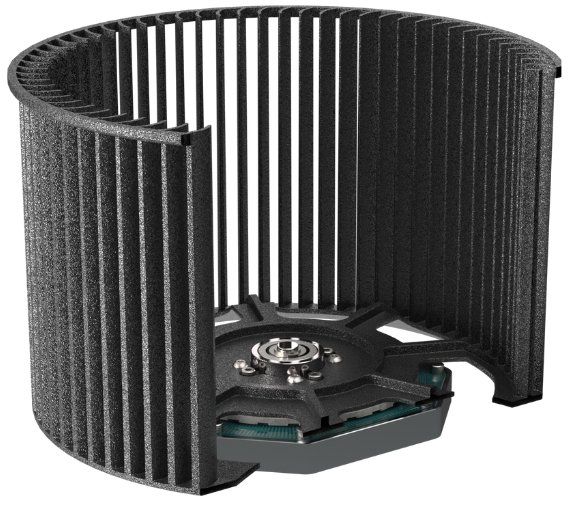
ECM Motors Offer Measured Efficiency & CFM/W Advantages in Blower Applications
Utilizing PrintStator Motor CAD, ECM integrated a PCB (Printed Circuit Board) Stator motor solution in a residential blower. This endeavor significantly enhanced system efficiency, CFM/W, and airflow performance of the blower system.
Transform Your HVAC products with ECM’s Expert Guidance.
FAQ's
What is the difference between motor efficiency and wire-to-air efficiency in HVAC systems?
Motor efficiency measures how much electrical power the motor converts to shaft power. Wire-to-air efficiency measures how effectively the complete motor and fan system moves air per watt of electrical input — accounting for the fan design, motor geometry, and how they interact. A motor with a high nameplate efficiency rating can still produce poor wire-to-air efficiency if it was not designed for the specific fan it drives, or if its physical geometry reduces airflow. ECM’s PCB Stator motors are co-designed to the fan curve, improving wire-to-air efficiency at the system level rather than just the motor level.
Why do HVAC motors underperform at partial load, and how does ECM address this?
Fixed-speed HVAC motors are designed to a standard operating point — typically rated speed and power. Below that point, efficiency degrades because the motor was sized for the peak condition, not the partial-load profile it runs at most of the time. Even variable-speed EC motors, which handle partial load better, are selected to a standard frame rather than co-designed to the specific fan curve and duty cycle. ECM’s PCB Stator motors are designed to your specific duty cycle, including turn-down operating points, using PrintStator. The air-core design also eliminates iron-core losses that worsen efficiency degradation at reduced load in conventional motors. In documented data centre cooling deployments, ECM motors maintained above 90% efficiency at low-speed off-peak cycles, not just at peak.
How long does it take to prototype a custom HVAC PCB Stator motor?
ECM’s prototype lead time is typically 6 to 16 weeks from specification lock, depending on application complexity and magnet availability. The speed comes from PrintStator, ECM’s proprietary motor CAD platform, which generates an optimized motor design from your fan curve and operating requirements in minutes, accurate to within 1 to 2% of measured performance. This compares to an industry-estimated 12 to 24 months for a conventional custom motor development program.
Are ECM's HVAC motors compatible with IE5 efficiency standards?
Yes. ECM’s PCB Stator motors can be designed to achieve IE5-class efficiency across the full operating range, not only at the nameplate rated point. IE5 compliance at real operating conditions is increasingly the benchmark for commercial HVAC OEM platforms, driven by EU ErP Directive and US DOE efficiency mandates. ECM’s co-design approach means the motor is optimized to your specific duty cycle, ensuring efficiency class is maintained at the operating points where your product is measured and sold.
Can ECM motors reduce the number of motor SKUs in a product range?
Yes. PrintStator can generate a family of motors covering multiple power levels and operating points from a single design architecture. One OEM partner used PrintStator to reduce their motor range from 12 SKUs to 4, covering 200W to 1.5kW across up to 12 distinct operating points per motor, while achieving IE5 efficiency throughout. Fewer SKUs simplify procurement, inventory management, and manufacturing, and reduce supply chain risk.