

Custom Actuation Solutions for Humanoid Robotics
Design lighter, smoother, and more scalable robotic joints with PCB Stator motor technology.
ECM designs custom PCB stator motors for humanoid robot actuators, cobots, prosthetics, and advanced robotic systems.
Using our PrintStator Motor CAD platform and patented PCB stator technology, we help robotics companies design motors around the joint, not around what’s available in a catalog.
Humanoid Robotics Is Converging on One Actuation Challenge
The humanoid robotics industry is moving from prototypes to production.
Nearly every humanoid robotics company now faces the same challenge: how to package enough torque, efficiency, thermal performance, control quality, and manufacturability into a human-scale joint.
Actuator decisions compound throughout the robot. A heavier wrist actuator increases the load on the elbow. A heavier elbow increases the load on the shoulder. Small design decisions at one joint can affect the performance of the entire system.
That is why leading robotics companies are increasingly moving toward application-specific actuator architectures rather than relying solely on off-the-shelf solutions.

Every Joint Has Different Requirements
A humanoid robot does not need one motor. It needs dozens of actuators, each solving a different problem.
An ankle actuator experiences different loads than a wrist. A shoulder actuator has different thermal and motion requirements than an elbow. Designing every joint around the same motor often forces compromises across the entire robot.
PrintStator allows engineers to optimize each motor around the actual requirements of its joint while considering the impact on the rest of the system.
This transforms motor selection from a component decision into a system-level design exercise.
Why Robotics Companies Work With ECM
Design Motors Around The Joint
Custom motors optimized for your torque-speed profile, duty cycle, packaging constraints, and actuator architecture.
Iterate Faster
Generate and optimize motor designs in seconds using PrintStator, allowing motor development to move at the same speed as the rest of the robot.
Improve Motion Quality
Zero cogging architecture delivers smooth, precise motion for humanoids, cobots, and human-interaction robots.
Reduce Weight
Optimize every motor for its application rather than accepting the compromises of a one-size-fits-all solution.
Scale To Production
Built on proven PCB manufacturing processes capable of supporting commercial-scale production.
Where PCB Stator Technology Has An Edge

Zero Cogging
Humanoid robots and collaborative robots require smooth, predictable motion.
Traditional iron-core motors generate cogging torque that can affect low-speed motion quality.
ECM’s air-core architecture eliminates cogging, enabling smooth motion and improved controllability in applications where precision and human interaction matter.
Flat Form Factor
ECM’s axial-flux motors are flat disks rather than traditional cylindrical motors. This geometry integrates naturally with harmonic, cycloidal, and planetary reductions, helping create compact actuator packages that fit within humanoid joints while maintaining a natural limb profile.
Large through-bores can also be incorporated to route cables, sensors, and pneumatic connections through the actuator.

Peak Torque Performance
Humanoid joints spend much of their time accelerating, decelerating, absorbing impact, and responding to changing loads.
ECM’s air-core architecture avoids the magnetic saturation effects that can limit performance in conventional motor designs, helping maintain predictable torque production during demanding operating conditions.

System-Level Optimization
Reducing mass at one joint reduces torque requirements throughout the rest of the robot.
PrintStator allows each motor to be designed as part of a complete system rather than as an isolated component, helping improve overall robot performance.

Built For Advanced Robotics Applications
ECM technology has been deployed across robotics, prosthetics, aerospace, precision motion systems, and advanced automation.
Relevant projects include:
- Humanoid robotic actuator development
- Through-bore robotic wrist systems
- Harvard prosthetic knee research
- Harmonic Drive integrations
- Precision optical positioning systems
For engineers who want a deeper technical comparison, download ECM102: Comparing Peak Torque.
How ECM Works
STEP 1
Discovery
Share your torque-speed requirements, duty cycle, packaging constraints, and system objectives.
STEP 2
Design
PrintStator generates and optimizes a custom motor design in seconds, with simulation accuracy typically within 1–2% of measured performance.
STEP 3
Prototype
Receive production-ready prototypes in as little as 6 to 24 weeks, with typical projects averaging approximately 16 weeks.
Ready to Design the Right Motor for Your Joint?
CASE STUDY
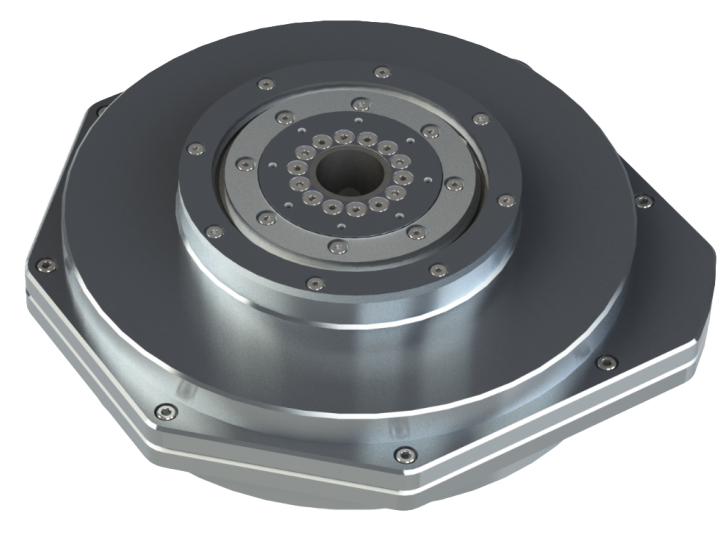
ECM integrates PCB Stator Technology into Robotic Joint Actuator applications
ECM has taken a significant leap by seamlessly integrating its state-of-the-art printed circuit board (PCB) stator technology into compact, powerful actuator assemblies designed specifically for robotic joint applications.
FAQ's
How long does a custom motor take to design and prototype?
PrintStator can generate a motor design in seconds. Prototype programs typically range from 6 to 24 weeks depending on project complexity, load, and magnet availability.
Can ECM support through-bore actuator designs?
Yes. Through-bore dimensions can be included as a design constraint, allowing cables, sensors, and pneumatic connections to pass directly through the motor.
Do ECM motors require an ECM controller?
Controllers should be considered early in the design process. ECM offers controller solutions optimized for PCB stator motors and can also discuss compatibility with existing control architectures.
Can ECM motors scale to production volumes?
Yes. PCB stator technology leverages established PCB manufacturing infrastructure, enabling scalable production without relying on specialized motor manufacturing facilities.
What applications are the best fit for PCB stator motors?
PCB stator motors are particularly well suited to applications requiring compact packaging, smooth motion, low noise, low cogging, high torque density, and application-specific optimization, including humanoid robotics, cobots, prosthetics, aerospace systems, and advanced automation.
Can ECM motors scale to production volumes?
Yes. ECM’s PCB stator manufacturing approach uses standard PCB fabrication technology, which is highly scalable. ECM has demonstrated scale-up to over 100,000 motors in less than one year using this approach. ECM stators can be manufactured anywhere there’s a capable PCB fabricator, including domestic suppliers, and the ancillary parts can be made using standard CNC machines, including through third parties. ECM can also provide the assembly tooling to customers who want to bring production in-house.