
Custom PCB Stator Motors for Pump OEMs
Co-Designed to Your Pump Curve.
When the motor is designed for the pump, not selected for it, the efficiency, weight, footprint, and supply chain all improve at once.
IE5
Efficiency Class
66%
Fewer Motor SKU’s*
*Documented customer case study
60%
Shorter Axial Length*
* Circulatory pump project
<16
Weeks to prototype*
* Average lead time

The Problem with Catalog Motor Selection.
Pump motors are almost always oversized. The efficiency loss is structural.
Most pump motors are specified for the worst-case operating point: peak torque, maximum flow, startup conditions. Then a safety margin on top. Field data shows most pump systems run at 40 to 70% of peak demand for the majority of their operating hours. A motor sized for the worst case runs inefficiently at the typical case, and that inefficiency is built in by design.
The motor geometry adds a second constraint. Conventional pump motors are cylindrical, and for good reason historically. But for pump platforms being designed or redesigned from scratch, that shape doesn’t need to be inherited. The axial disc form factor changes what integration is possible.
Why PCB Stator Motors for Pump OEMs

IE5-class
efficiency
at real operating points
ECM’s air-core design eliminates iron-core losses that cause conventional motors to degrade at partial load. Efficiency is maintained across the full operating range. In a documented dosing pump application, the PCB Stator motor achieved IE5 with a 10% efficiency improvement over the conventional alternative. Most pump systems spend the majority of their operating hours below peak , ECM motors are designed for that reality.

Designed to your pump curve
not the nearest catalogue frame
PrintStator generates an optimized motor design from your pump curve, duty cycle, and operating profile. The result is a motor that runs efficiently at your real operating points, including turn-down, not at a standard nameplate condition you rarely reach. Co-designing the motor to the load is how ECM achieves efficiency gains that catalog selection fundamentally cannot.

Precise variable speed control
high degree of controllability across the full operating range
PCB Stator motors offer a high degree of controllability across the full operating range. Linear torque-speed behavior, sinusoidal back-EMF, and zero cogging are inherent characteristics of the air-core topology, and because these motor characteristics are outputs of the PrintStator model, controller hardware and firmware can be developed in parallel with the motor. For dosing and metering pumps where delivery accuracy at low speed is the primary specification, this is the characteristic that matters most. Flow is controlled by the motor, not by valves wasting energy downstream.

Up to 70% lighter, up to 60% shorter
simpler integration, less mechanical stress, 80% less raw material
In a documented 3HP application, the ECM motor weighed 22 lbs versus 69 lbs for the market-leading alternative, with an axial length of 100mm versus 424mm. Iron laminations and copper windings are replaced by precision-etched PCB traces, cutting mass by up to 68% and raw material use by up to 80%. Lighter, shorter motors reduce shaft loads, simplify mounting, and enable co-axial pump integration that cylindrical motors make impossible.

Quiet operation
lower acoustic signature including noise that couples to the pumped fluid
ECM’s air-core design eliminates the harmonic distortion that causes acoustic noise in conventional iron-core motors. In pump applications, this matters beyond the motor itself, reducing motor noise that couples to the pumped fluid and into connected pipework. For marine, medical, and occupied-space pump applications where acoustic performance is a specification requirement, this is a meaningful advantage over conventional EC motor solutions.

Simpler supply chain
fewer SKUs, no specialist winding facility, globally manufactured
PrintStator can generate a family of motors across multiple power levels from a single design architecture. One OEM partner consolidated from 40+ motor variants to 15 finished products: a 66% reduction in SKUs and 63% reduction in finished goods. ECM stators are produced using global PCB manufacturing. No specialist winding facility, no single-source risk. Customers can integrate motor assembly directly into their own production line.

In-house assembly ready
vertical integration at scale
ECM stators are produced using standard global PCB manufacturing, no specialist winding facility required.
One OEM partner scaled to 200,000+ motors per year with just 2 staff. Full control over quality, IP, and production timing.

Prototype in weeks
versus 12 to 24 months conventionally
PrintStator generates an optimized motor design from your pump curve specifications
in minutes, accurate to within 1 to 2% of measured performance. Prototype lead time
typically runs between 6 and 24 weeks from specification lock, with most projects
completing around 16 weeks, compared to an industry-estimated 12 to 24 months for
conventional custom motor development.
Saltwater
Pool Pump
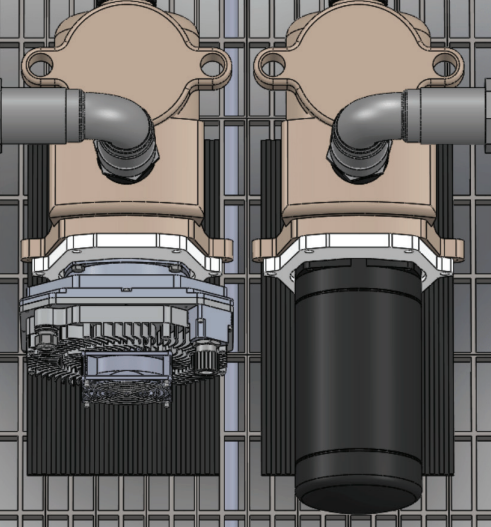
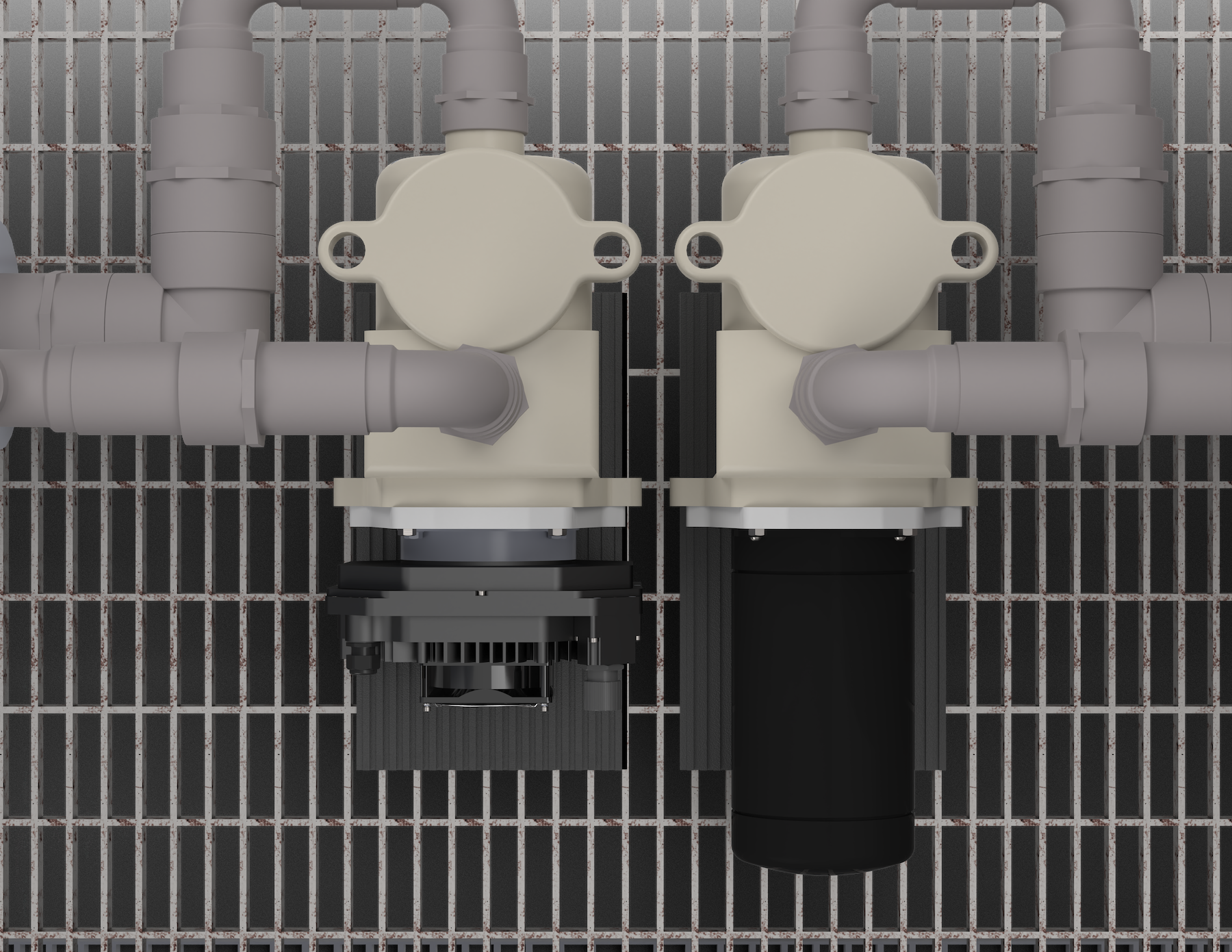
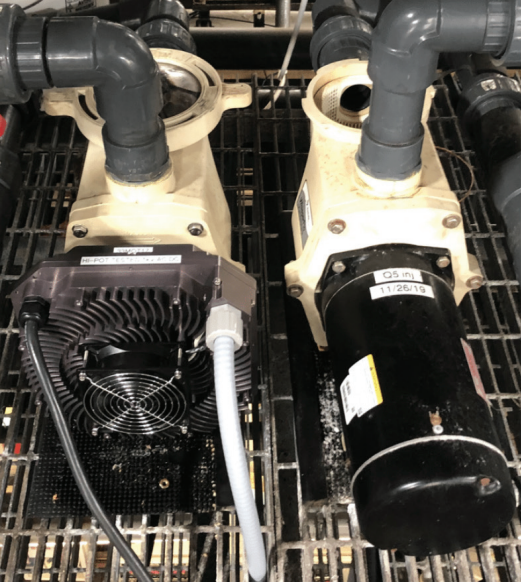
20cm Shorter
5kg Lighter
6% More efficient
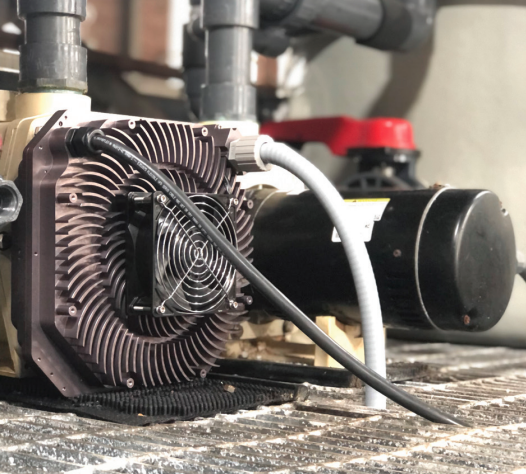
Conventional motors in the saltwater pump application failed from corrosion every 6 to 8 months. The fully enclosed PCB Stator design eliminates exposure to salt air, delivering stable long-term operation with reduced maintenance and replacement cycles, alongside a shorter, lighter, and more efficient motor.
Eliminating corrosion failure. Enabling long-term operation in salt air.
Circulatory Pump
60% Length reduction
IE5 Efficiency class
1 Person to install
The compact axial design reduced motor length by 60%, simplified installation to a single-person task, and enabled a single motor platform to replace multiple variants across the product range. The design supports vertical integration — customers can bring motor assembly in-house using ECM’s PCB-based production process.
Single motor platform replaces multiple variants. Enables vertical integration.
Dosing Pump
50% Weight reduction
10% Efficiency improvement
IE5 Efficiency class
The motor was designed exactly to the dosing pump’s operating point using PrintStator. No oversizing. Improved efficiency, reduced cost, and direct integration with the pump body. Without iron in the stator, ECM motors maintain linear torque control at low speeds, enabling accurate flow delivery without downstream valve throttling. The motor controls the dose. The valve doesn’t.
Right Motor. Right Operating Point. Right Dose. No Oversizing.

Is ECM the Right Fit?
ECM is a strong fit when:
- The pump system is being designed or redesigned from scratch, where the motor is a genuine design variable.
- IE5 efficiency at real operating conditions, including turn-down, is a product requirement.
- Form factor, weight, or axial length affects system integration or installation.
- Controllability at variable speed, including dosing and metering accuracy at low speed, is a specification requirement.
- Supply chain simplification or in-house motor assembly is a commercial or operational priority.
ECM is less likely to be the right fit when:
- The existing motor is in a fixed cylindrical housing that cannot be modified. The flat disc geometry requires a flat integration space. Forcing it into a cylindrical envelope typically increases cost.
- Cost is the only selection criterion and a standard catalogue motor meets the efficiency requirement. ECM’s co-development investment is justified by performance and program value, not by price competition.
- Production volumes are very low and the engineering investment does not return within a reasonable program timeline.
FAQ's
What is the efficiency advantage of ECM's pump motor versus a conventional alternative?
In a documented 3HP application, ECM’s PCB Stator motor achieved 94% efficiency, 2.9 percentage points above the market-leading alternative at the same power class. In a separate dosing pump application, the PCB Stator motor achieved a 10% efficiency improvement over the conventional design at IE5 class. ECM’s flat efficiency curve means the motor maintains high efficiency at partial load — where most pump systems spend the majority of their operating hours — not just at the nameplate rated point.
How does ECM reduce pump motor SKU complexity?
PrintStator generates optimized motor designs from your specifications in minutes. Because ECM designs the motor to the application rather than selecting the nearest standard frame, a single design architecture covers multiple power levels and operating points. In one documented case, an OEM consolidated from 40+ motor variants to 15 finished products — a 66% reduction in motor SKUs and 63% reduction in finished goods. In a separate case, a European OEM reduced their motor range from 12 SKUs to 4. Both results come from the same core principle: one optimized platform, engineered to the real operating profile.
Can ECM motors be assembled in-house as part of a pump manufacturer's production process?
Yes. ECM’s PCB stators are manufactured using standard global PCB fabrication, no specialist motor winding process required. Customers can integrate ECM motor assembly directly into their production line with a simple 6-step process. One partner operated a production with with 2 staff across 2 shifts, producing 200,000+ motors per year. This enables full control over quality, production timing, and IP — and eliminates the motor as a separately procured sub-assembly.
What pump applications are best suited to ECM's PCB Stator technology?
ECM’s strongest pump applications are those where the motor is a meaningful design variable — where efficiency class at real operating conditions, form factor, weight, or supply chain simplification affects the end product. This includes circulatory pumps (axial form factor and weight reduction), dosing and metering pumps (controllability at variable and low speed), industrial process pumps (SKU reduction and IE5 compliance), and marine pump applications (lightweight, corrosion-resistant enclosed design). ECM is less suited to applications where the existing motor is fixed in a cylindrical housing that cannot be modified, or where cost is the only selection criterion.
How does ECM compare to conventional motor technologies at 5HP?
In a direct 5HP comparison at identical torque (20Nm), speed (1,800rpm), power (3,700W), and IE5 efficiency, ECM’s PCB Stator motor is lighter and shorter than all four competing motor architectures: AC induction (120 lbs), EC motor (73 lbs), synchronous reluctance (98 lbs), and other axial flux designs (86 lbs). ECM: 49 lbs. When all technologies achieve IE5, the differentiator is what IE5 costs you in weight and footprint. For pump OEMs where motor size and mass affect system design, the gap is substantial.
CASE STUDY
ECM Displays advantages of PCB Stator Technology for pump motor applications
ECM was recently commissioned by the New England Aquarium, in Boston Massachusetts, to replace a conventional 2.2kW pump motor with a custom PCB stator motor solution. The specific circulation pump of discussion services a tank responsible for the rehabilitation of injured sea turtles.