
Custom PCB Stator Motors for Robotics and Actuation
Designed for the Joint. Not Selected for It.
When the motor is designed around the joint, not picked from a catalog, quality of motion, weight, axial length, and peak torque all change.
50%
Reduction in Axial Length
documented joint case study
50%
Reduction in mass
same torque and speed
Zero
Cogging Torque
Air-core – all speeds
16.7M
Encoder positions
24-bit absolute

The Problem with Catalog Motor Selection in Robotics.
Conventional servo motors are cylindrical, a shape inherited from industrial machinery, not articulated joints. In a six-axis robot, a longer motor means a longer joint, a heavier arm, and a reduced payload.
Engineers manage it by overspecifying. The system ends up carrying itself. And the datasheet comparison isn’t straightforward either, ECM’s nominal torque looks lower than a conventional servo’s peak, but the definitions differ. At the pulse widths that matter for robot joint maneuvers, the numbers converge.
The better question is not which datasheet number is larger. It is how much does the competitor’s motor weigh for the required torque, compared to an ECM motor designed specifically for that requirement.
Why PCB Stator Motors for Robotics OEMs

Zero cogging, smooth quality of motion
the best possible choice for cobots and human interaction robots
ECM’s air-core design produces zero cogging torque, the motor has no preferred rotor position and no pulsating resistance to motion. The result is smooth, natural-feeling movement at all speeds. For collaborative robots that operate alongside people, and for surgical and haptic applications, quality of motion is a safety and user experience requirement. Achieving the full potential requires advanced control and careful motor design, both of which ECM provides.
Flat form factor — designed for joint integration
integrates with strain-wave, cycloidal, and planetary reductions
ECM’s axial disc form factor complements the geometry of strain-wave, cycloidal, and planetary gearboxes. ECM is highly experienced at tight integrations of sensors and reductions in critical applications with minimum extra space. ECM’s harmonic drive integration is smaller, lighter, and achieves higher specific torque than Harmonic Drive’s own integration, documented in a published case study.

High peak torque with linear torque/ current
peak defined by thermal limits, not a linearity cutoff
Iron-core servos define peak torque as the point where the torque/current curve departs from linear, a control limit, not a physical one. ECM’s air-core design maintains linearity well beyond the nominal rating. Peak torque is instead set by thermal hotspot models and pulse duration. At 110ms, a realistic robot joint maneuver, ECM matches the peak specific torque of a leading frameless servo. ECM102 explains the full comparison.

Excellent controllability across the full range
linear performance from low speed to peak torque
ECM motors maintain linearity throughout their rated range and extend linear operation into the peak-torque thermal regime. ECM motors are well-suited for field-oriented sensorless control. ECM has developed a proprietary observer and embedded software platform that runs across the full range of controllers and motor sizes, showing ECM motors at their full potential rather than underperforming with a

Low acoustic signature
quieter operation across the full speed range
ECM motors have fully encapsulated windings, lack magnetic material that sees a substantial time-varying field, and produce no axial force density on the stator. These characteristics combine to offer good acoustic performance relative to conventional machines, a quality that can be optimized for in the design phase. For cobots in occupied workspaces and surgical robotics, acoustic performance matters. Note: proper control is required to achieve this advantage.

Up to 50% lighter at equivalent performance
mass reduction that compounds across every joint
In a published robotic joint case study, ECM delivered 1.25kg versus 2.5kg for the conventional servo integration at identical continuous torque (24Nm), peak torque (57Nm), and max speed (4,800rpm). In a multi-joint robot, lighter actuators at each joint reduce the torque requirement downstream. ECM uses up to 80% less raw material than conventional wound stator designs.

Precision design — encoder to system level
24-bit absolute encoder, dual encoder support, system co-optimization across all joints
ECM motors support integrated 24-bit absolute encoders, enabling 16,777,216 discrete positions. ECM’s controllers support dual-encoder applications, and drives can be integrated or located remotely. PrintStator co-designs each motor in the kinematic chain with knowledge of what the others are doing, accurate to within 1 to 2% on critical parameters, so the system ends up lighter and more efficient than an independently specified set.

Prototype in weeks — at a fraction of the cost
6 to 16 weeks and an order of magnitude less expensive
ECM designs custom motors at a rate that far exceeds conventional development. In many cases, an ECM servo solution is a fraction of the cost of an off-the-shelf servo. Prototype capability is typically 6 to 16 weeks, compared to 1 to 2 years conventionally. ECM’s prototype is most likely an order of magnitude less expensive than a from-scratch conventional design, for programs where volume and application justify the investment.
PCB Stator Technology in Robotic Joint Actuator Applications
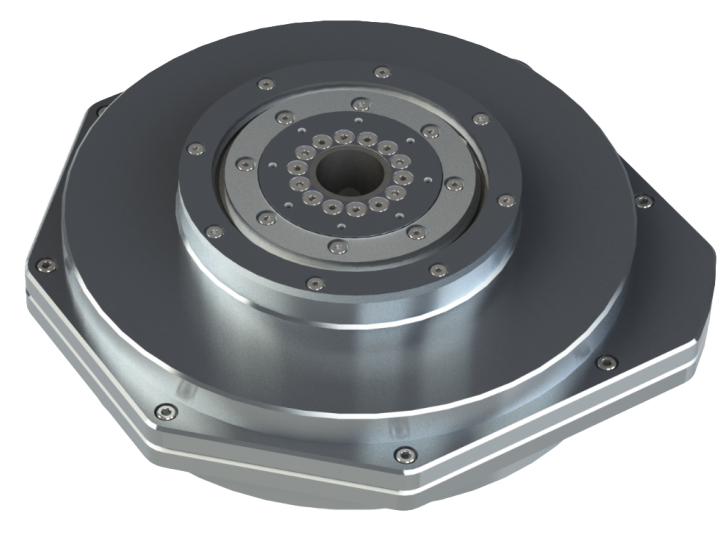
ECM partnered with Cone Drive to develop a compact hollow shaft actuator integrating PCB Stator technology with a strain wave gearbox at 100:1 reduction.At identical torque and speed: 39.9mm versus 78mm axial length, 1.25kg versus 2.5kg mass.
Half the length. Half the weight. Same performance.
High-Precision Delta Robot Demo — ECM Servo Evaluation Motors in Action
ECM’s servo evaluation motors were demonstrated on a high-precision delta robot, showcasing fast settling, precise multi-axis motion, and low acoustic noise under high-speed movement. The demo illustrates the quality of motion advantage of PCB Stator motors in dynamic robotic applications — smooth, responsive, and quiet across the full operating range.
Comparing Peak Torque: ECM and Typical Robot Actuator Motors
Published by Dr Steven Shaw (CTO) and Dr Eric Ponce (Director of R&D). Explains why peak torque comparisons between iron-core servos and ECM air-core motors require aligned assumptions. At 110ms pulse width, ECM’s 0.5Nm shelfstock motor achieves 12.87 Nm/kg — matching the linearity-limited peak specific torque of the TQ ILK-E50x14 frameless servo (12.76 Nm/kg).

Is ECM the Right Fit?
ECM is a strong fit when:
- The program is being designed from scratch, where joint geometry, gearbox interface, and motor can be co-designed together.
- Quality of motion matters, cobots, surgical robots, haptic systems, or any application where smooth, cog-free motion at all speeds is a safety or user experience requirement.
- Axial length or mass at each joint has direct consequences for payload rating, reach, or safety certification.
- High peak torque is required for short maneuvers, and you want the comparison made on aligned pulse-width assumptions rather than mismatched datasheet definitions.
- System-level co-optimization across multiple joints has commercial value, lighter actuators at every joint, better efficiency across the full arm.
- An ECM servo solution at a fraction of the cost of an off-the-shelf servo is relevant to your program economics.
ECM is less likely to be the right fit when:
- There is a need to fit exactly in the space allocated for a radial flux machine — for example, a second source or form-factor replacement. It is generally not possible to design a competitive axial flux motor within a radial flux form factor constraint.
- The motor comparison is being driven by specific torque figures on a datasheet. The right question is how much does the competitor’s motor weigh for the required torque, compared to an ECM motor designed specifically for that requirement.
- The application has extreme environmental conditions, running in water, waste, or extreme temperatures, that involve design considerations difficult to incorporate in an optimization.
FAQ's
Why are ECM motors described as the best choice for collaborative robots?
ECM’s air-core design produces zero cogging torque, no preferred rotor positions, no pulsating resistance to motion at any speed. Combined with linear torque/current characteristics and ECM’s proprietary controller platform, the result is smooth, natural-feeling motion that conventional iron-core servos cannot match without significant control software overhead. For collaborative robots that work alongside people, and for surgical and haptic applications where the robot’s motion quality directly affects safety and user experience, this is the defining advantage.
Why are ECM motors described as the best choice for collaborative robots?
Because the definitions of peak torque are different. Conventional iron-core servo motors define peak torque as the point where the torque/current curve departs by a set percentage from the linear model, a linearity limit. ECM’s air-core motors maintain torque/current linearity well beyond the nominal rating, so ECM’s peak is set by thermal hotspot models and pulse duration. When the same pulse width is applied — 110ms, a realistic robot joint maneuver duration — ECM matches the peak specific torque of a leading frameless servo. The right question is not which datasheet number is larger. It is how much does the competitor’s motor weigh for the required torque, compared to an ECM motor designed specifically for that requirement. ECM Technical Note ECM102 explains the full comparison.
Can ECM motors integrate directly with strain wave and harmonic drive gearboxes?
Yes. ECM is highly experienced at performing tight integrations of sensors and reductions in critical applications with minimum extra space. ECM’s harmonic drive integration is smaller, lighter, and achieves higher specific torque than Harmonic Drive’s own integration, documented in a published case study. The axial disc geometry of ECM’s motors complements the disc geometry of strain wave and cycloidal gearboxes directly. Hollow shaft designs are also straightforward to implement.
How does ECM co-design motors for multi-joint robotic systems?
PrintStator enables system-level motor design accurate to within 1 to 2% on critical parameters. Each motor is designed with knowledge of what the others are doing in the kinematic chain. The roll motor is designed first. The tilt motor is optimized using the roll motor output. The pan motor is co-designed using both. The system ends up lighter and more efficient than an independently specified set without any change to the kinematic architecture. This process is possible because ECM’s design executes in roughly a second per iteration, enabling rapid co-design with the rest of the product.
Is ECM a drop-in replacement for an existing servo motor?
Generally not. ECM will likely not be competitive if there is a need to fit in exactly the space allocated for a radial flux machine — for example, a second source or cost reduction in an existing application. It is very difficult to design a competitive axial flux motor within a radial flux form factor constraint. ECM’s strongest advantage is in programs being designed from scratch, where the joint geometry, gearbox interface, and motor can be co-designed together from the start.
CASE STUDY
ECM integrates PCB Stator Technology into Robotic Joint Actuator applications
ECM has taken a significant leap by seamlessly integrating its state-of-the-art printed circuit board (PCB) stator technology into compact, powerful actuator assemblies designed specifically for robotic joint applications.